NSBA commends Congress for its work to ensure important tax and policy wins among our top Priority Issues in HR1.
NSBA commends Congress for its work to ensure important tax and policy wins among our top Priority Issues in HR1.
16 JULY 2025 | This week, NSBA continues to celebrate its wins secured from Capitol Hill to the White House that ensure important tax and policy provisions vital to the small-business community.
RELATED | NSBA Mid-Year Report - BIG WINS FOR SMALL BUSINESS IN 119TH CONGRESS
The following are the wins NSBA is proud to lead through our members' voice and advocacy:
Key Business Provisions from H.R. 1
Extension and Enhancement of Deduction for Qualified Business Income (Section 199A
Deduction)
- Makes the Section 199A deduction for qualified business income permanent beyond its original 2025 expiration.
- Retains the 20% deduction for qualified income from passthrough entities and sole proprietorships. Increases the deduction limit phase-in range for specified service trades or businesses (SSTBs) and other taxpayers subject to wage and investment limitations by $25,000 for single filers and $50,000 for joint filers.
- Introduces a $400 minimum deduction (indexed for inflation) for filers with at least $1,000 in qualified business income and material participation.
Extension and Enhancement of Reduced Rates (Individual / Pass-Through Marginal
Rates)
- Permanently extends the reduced individual income tax brackets enacted by the Tax
- Cuts and Jobs Act of 2017, which were otherwise scheduled to expire after 2025.
- Bracket thresholds are also adjusted upward slightly through continued inflation indexing.
Extension of Estate Tax Exemption Thresholds
- Preserves and makes permanent the $15 million estate tax exemption ($30 million for joint filers) – otherwise set to expire and revert to a $7 million level post-2025 – while indexing the threshold for inflation going forward.
Business SALT Deductions
- Preserves the ability of pass-through businesses to utilize state-level pass-through entity tax (PTET) regimes to deduct the full amount of their SALT (which are otherwise capped). Increases the $10,000 cap on SALT deductions claimed by individual taxpayers to $40,000, with an income phaseout. Pass-through businesses that do not elect to be taxed at the entity level under a PTET are therefore subject to the new $40,000 limit.
Domestic Research and Experimental Expenditures
- Restores and makes permanent the full and immediate deduction of domestic research and experimental (R&E, or more commonly “R&D”) expenditures under Section 174, retroactive to January 1, 2025. Establishes a carveout for small businesses with less than $31 million in gross receipts (indexed for inflation going forward), allowing them to immediately capitalize unrecouped R&E costs, retroactive to 2022. Foreign R&E expenditures must still be amortized over 15 years.
Full Expensing for Certain Business Property (Bonus Depreciation)
- Makes permanent 100% bonus depreciation for qualified property placed in service after January 19, 2025. Applies to machinery, equipment, and certain building improvements.
- Reverses the TCJA’s phasedown schedule that would have ultimately eliminated thebenefit in 2027.
Expanded Section 179 Expensing
- Doubles the Section 179 expensing limit to $2.5 million, with a phase-out threshold starting at $4 million. Both figures will be indexed for inflation after 2025. The provision effectively mirrors bonus depreciation / full expensing, but given its restrictions on dollar amount of eligible property is directed at small businesses. Section 179 has historically allowed qualifying businesses to still fully write off eligible assets when bonus depreciation percentages are phased out or otherwise reduced.
Allowance of Bronze and Catastrophic Plans in Connection with Health Savings
Accounts (HSAs)
- Expands eligibility for Health Savings Accounts (HSAs) by allowing individuals enrolled in bronze or catastrophic plans to make HSA contributions. (The expansion is far narrower in scope than those proposed by an earlier draft, which made numerous changes to HSAs and ICHRAs.)
Modification of Limitation on Business Interest Deduction (Section 163(j))
- Reverts and makes permanent the calculation of the Section 163(j) interest expense limitation to use earnings before interest, taxes, depreciation, and amortization (EBITDA), rather than the more restrictive EBIT standard.
Increase in Threshold for Digital Payments Reporting Threshold (1099-K Threshold)
- Repeals the $600 threshold for Form 1099-K reporting introduced by the American Rescue Plan Act, which generally applies to payments made / received via certain digital platforms (e.g. Venmo, PayPal). Restores the previous threshold of $20,000 in aggregate payments and 200 transactions, effective next year.
Enforcement Provisions with Respect to COVID-Related Employee Retention Credits
(ERC)
- Bars new Employee Retention Credit claims filed after January 31, 2024. Extends the statute of limitations for enforcement and fraud prosecution related to the ERC.
- Establishes new penalties for improper claims and provides resources for IRS enforcement targeting “ERC promoters.”
Expansion of Qualified Small Business Stock Gain Exclusion (QSBS)
- Creates a tiered structure for capital gains exclusion on Qualified Small Business Stock: 50% exclusion after 3 years, 75% after 4 years, and 100% after 5 years of holding. Also increases the lifetime per-issuer exclusion cap from $10 million to $15 million.
Enhancement of Employer-Provided Child Care Credit
- Increases the credit rate for qualified employer-provided child care expenses from 25% to 40%, and raises the maximum credit amount to $500,000. For small businesses (defined under Section 448(c)), the credit rate is further increased to 50% and the cap is raised to $600,000. Applies to tax years beginning after 2024.
No Tax on Tips / Overtime
- Creates a new deduction of up to $25,000 for income received as tips; the provision is retroactive to 1/1/2025 and runs through the 2028 tax year, reportable on Forms W-2 and 1099, and has a phaseout starting at $150,000 in AGI ($300,000 for joint filers).
- Directs Treasury to propose regulations around the new benefit within 90 days, most notably which occupations are eligible. Establishes a similar benefit for overtime pay, with the maximum deduction set at $12,500 ($25,000 for joint filers).
Read and download the full document here.
___
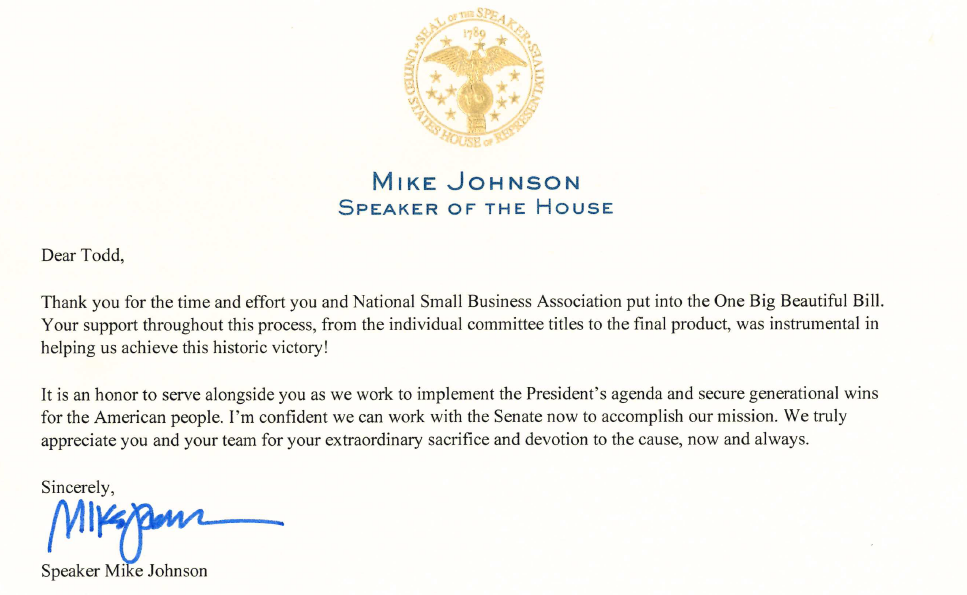
Following passage of H.R. 1, Speaker Mike Johnson (R-La.) shared a personal thank you note with NSBA for urging our membership to advocate for strong small-business provisions included in its final passage.
____