

NSBA continues urging Congress to remember the regulatory burdens small-business owners face from the constant shift of definitions and rules, including the joint employer rule, commending leaders in Washington for pursuit of common sense standards best serving the nation's most important economic community.
NSBA continues urging Congress to remember the regulatory burdens small-business owners face from the constant shift of definitions and rules, including the joint employer rule, commending leaders in Washington for pursuit of common sense standards best serving the nation's most important economic community.
UPDATE, Jan. 15, 2026 | A highly anticipated effort on Capitol Hill to overturn the National Labor Relations Board’s (NLRB) controversial joint-employer rule collapsed yesterday, leaving small-business owners without the certainty they urgently need on labor liability standards.
With business groups and advocates pushing back against the NLRB’s 2023 attempt to expand the joint-employer standard, a rule that would have made it easier for small and mid-size businesses to be legally linked to workers employed by contractors or franchisees, opponents argued the rule would significantly increase compliance burdens, litigation risk, and liability for everyday employers who lack the legal staff of larger companies.
In response, the House passed a Congressional Review Act (CRA) resolution aiming to nullify the rule, and the Senate even voted to approve it in 2024.
However, recent efforts to revisit the issue and force a new vote on repealing or reforming the joint-employer standard were abruptly derailed yesterday, when leadership pulled the measure hours before it was scheduled to come to the floor. This collapse reflects ongoing divisions in Congress, even on issues where small-business support for reform has historically crossed party lines, underscoring the challenges in securing clear, consistent labor rules for employers.
For small businesses, the joint-employer standard isn’t just a legal abstraction: it determines when a company can be held liable for another employer’s workforce, affecting everything from franchise relationships to subcontracted labor. Clear rules help small businesses plan for growth, hire confidently, and manage risk, but continued uncertainty leaves many owners exposed to labor-related liability and unpredictable costs.
NSBA continues advocating for sensible joint-employer reform that protects small businesses from undue legal risk while maintaining fair labor standards. We will keep members updated as lawmakers regroup and explore alternative paths forward to provide the clarity and certainty America’s small businesses deserve.
____
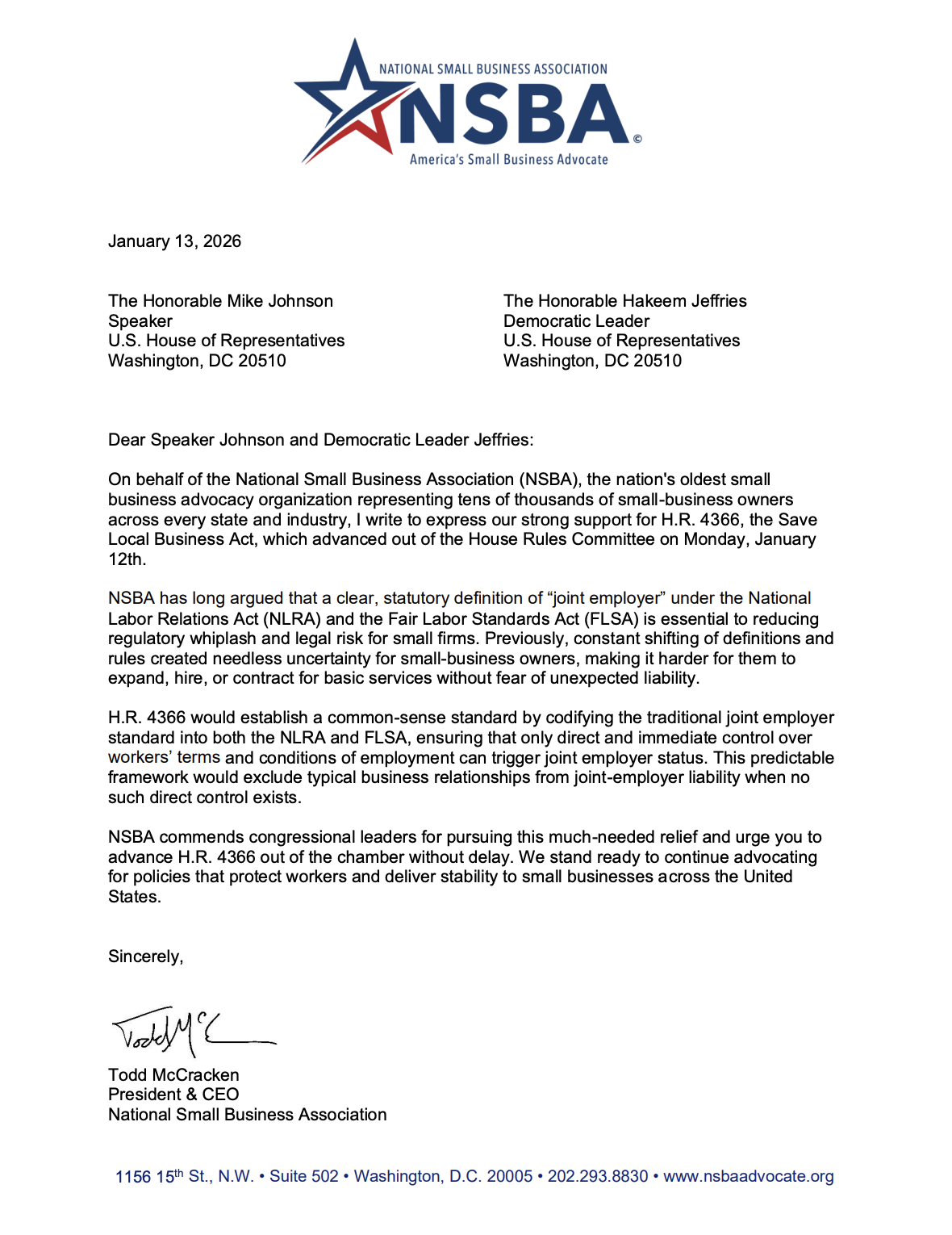
UPDATE, JAN. 13, 2026 | On Jan. 12, H.R. 4366, the Save Local Business Act, favorably advanced from a House Rules Committee hearing. Expressing support for this legislation, NSBA shared the following letter with House leaders ahead of a prospective full chamber vote.
Read the full letter here:
____
JAN. 12, 2026, | THIS WEEK, the House is set to move forward with legislation that could provide long-sought certainty for small-business owners navigating complex labor rules. H.R. 4366, the Save Local Business Act, would establish a clear, statutory definition of “joint employer” for small-business owners under both the National Labor Relations Act (NLRA) and the Fair Labor Standards Act (FLSA). This is a change NSBA has long argued is essential to reducing regulatory whiplash and legal risk for small firms.
Under the bill, a small business would be considered a joint employer only if it directly, actually, and immediately exercises significant control over another company’s employees. That includes core actions such as hiring and firing, setting pay and benefits, supervising day-to-day work, assigning schedules or tasks, and disciplining employees.
Businesses that do not directly control these essential terms, such as franchise owners, companies using contractors or staffing agencies, or firms working with vendors, would generally be excluded from joint-employer liability.
For small businesses, the stakes are high. Over the past decade, shifting definitions from the National Labor Relations Board (NLRB) and the Department of Labor have created uncertainty that makes it harder to expand, franchise, or even contract for basic services without risking unexpected legal exposure. Supporters of H.R. 4366 argue that codifying a consistent standard would allow small businesses to plan, hire, and grow with confidence, minimizing concern and uncertainty that a future regulatory change could suddenly redefine them as an employer of workers they do not manage or pay.
House Education and Workforce Committee Chairman Tim Walberg (R-Mich.) underscored that uncertainty, noting that unclear joint-employer rules discourage entrepreneurship and expansion by driving up compliance costs and legal risk. Business groups across industries, including franchising, manufacturing, hospitality, construction, and retail, have rallied behind the bill, emphasizing that accountability should rest with an employee’s actual employer.
Opponents, including congressional Democrats and organized labor, argue the bill could weaken worker protections and limit accountability in situations where multiple entities influence working conditions. They contend it could reduce workers’ ability to seek recourse for wage theft, child labor violations, or collective bargaining issues when subcontracting or staffing arrangements are involved.
The Save Local Business Act cleared the House Education and Workforce Committee on a party-line vote and is now headed toward floor consideration, with the House Rules Committee set to determine debate terms soon. Passage would require a simple majority.
At its core, this debate is about predictability. Small businesses rely on franchise models, contractors, and partnerships to compete and grow. A clear, stable joint-employer standard would help ensure that responsibility and liability tracks real control, not shifting interpretations.
NSBA will continue to monitor the bill closely and advocate for policies that protect workers while allowing small businesses the certainty they need to create jobs and serve their communities.